Final Reflection
Aminata Camara
Professor Amy Albuerme Oìie
English 110
Dec 17, 2025
English Doesn’t Define Who You Are
Throughout this semester I learn and realize that English does not and should not define who you are as a person. This idea came up repeatedly in our readings, class discussions, and my own writing assignments. I came into this course believing that good English was something you had to master perfectly in order to be taken seriously. But the work we did this semester complicated that assumption and taught me that language is more than grammar rules but it is identity, culture, and lived experience. Reflecting on my growth now, I can see how my understanding of language shifted from something that limited me to something that represents me.
This semester showed that writing improves when students stop trying to sound overly academic and instead let their natural voice guide their ideas.My own writing this semester became evidence of this growth. Early on, I worried that my essays sounded wrong or less academic. But as we moved through assignments from reading discussions to the unit analyses to the longer essays I found myself writing more confidently. I began letting my natural voice appear on the page instead of forcing myself into stiff academic language. Even in my research essays I realized that clarity and honesty matter more than trying to sound like someone else. This freedom helped me put more meaning into my writing rather than just focusing on sounding correct. Reading Vershawn Ashanti Young’s “Should Writers Use Their Own English?” reinforced this shift in a powerful way. Young argues that forcing everyone to write in one standardized version of English actually limits expression and shuts down students’ real voices. He said that people have the right to use the language that reflects who they are because language is tied to identity, culture, and experience. When I read his point that “code-meshing” is not a mistake but a skill, it made me rethink the idea that academic writing has to sound one specific way. Instead of trying to erase my own voice to sound more proper, I started embracing the idea that my natural style has value. Young even writes that “everybody mixes the dialect they learn from home with the dialect they learn at school,” which showed me that blending languages or styles is natural, not something to fix. He also said that “code meshing is the new code switching,” which helped me understand that using different Englishes together can make writing richer and more authentic. Hearing Young argue that teachers should “encourage students to bring their home voices into the classroom” made me feel like my own voice actually belongs in academic spaces.
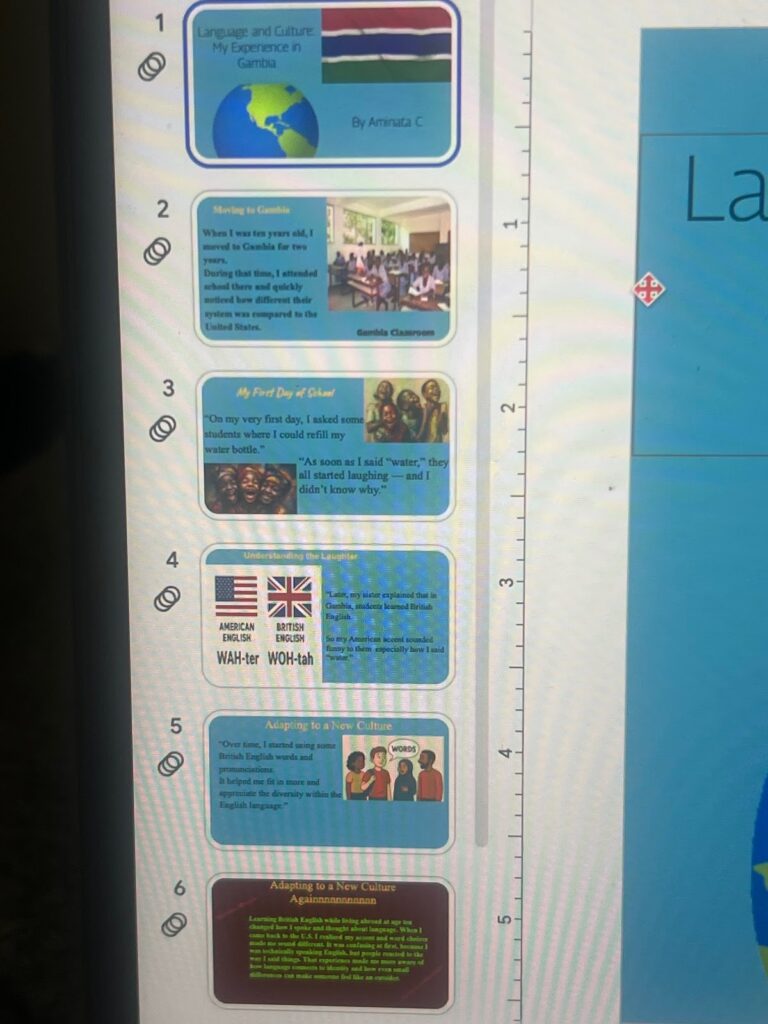
Judging people by their accents is unfair because the way someone speaks does not show how smart they are but it only shows where they come from and the languages they have learned. important moment was when we discussed accent discrimination. Writing my essay about African immigrant students taught me how deeply language affects identity and confidence. Research showed that accents are not signs of being uneducated; they are signs of multilingualism and migration.Working on this assignment also pushed me to reflect on my own experiences and the way I was judged on the way I speak.For example ”Later, my sister explained that in Gambia, the students learned and spoke British English, so the way I pronounced “water” in my American accent sounded unusual to them.”.I started noticing how often society treats perfect or standardized English as the measure of intelligence and success. This made me realize how unfair and harmful that idea is, especially to immigrants and students who are still learning or balancing multiple languages. People are often ignored, underestimated, or disrespected simply because their speech sounds different, even though their ideas and knowledge are just as strong. This supported my claim that English doesn’t define you, it only reflects one part of your story.
Peer workshops help students get past language barriers by showing that you don’t have to speak perfect English to share strong ideas, and that different ways of using language should be respected.Even peer workshops contributed to my learning. When classmates read my drafts, they never said your English is wrong. Instead, they focused on my ideas, my arguments, and the examples I chose. That made me realize that the value of writing comes from what you are saying, not how native you sound. The classroom community we built showed me that communication is about connection, not correctionI also learned how much feedback can shape an idea. Every comment from a classmate pushed me to think deeper and be more intentional about my claims. Instead of just writing to finish an assignment, I started writing to communicate something real. Feedback wasn’t about fixing mistakes but it was about helping each other grow.These workshops taught me how to listen, too. When I read other students’ drafts, I realized how many different ways a person can express themselves. It made me appreciate that writing doesn’t have one “correct” voice. Everyone brings their own experiences, rhythms, and ways of seeing the world. Learning to recognize and respect that made me a better writer and a better reader.