Self-Assessment
Learning Objective #1: Examine how attitudes toward linguistic standards empower and oppress language users.
My paraphrase:
I learned that the rules people think are “correct” in language can affect how others are treated, sometimes giving them advantages and sometimes holding them back.
Evidence of learning:
In class, we read articles about different ways people speak, like regional dialects and internet slang. I noticed that some ways of speaking are respected while others are looked down on, which can make people feel included or excluded depending on how they talk.
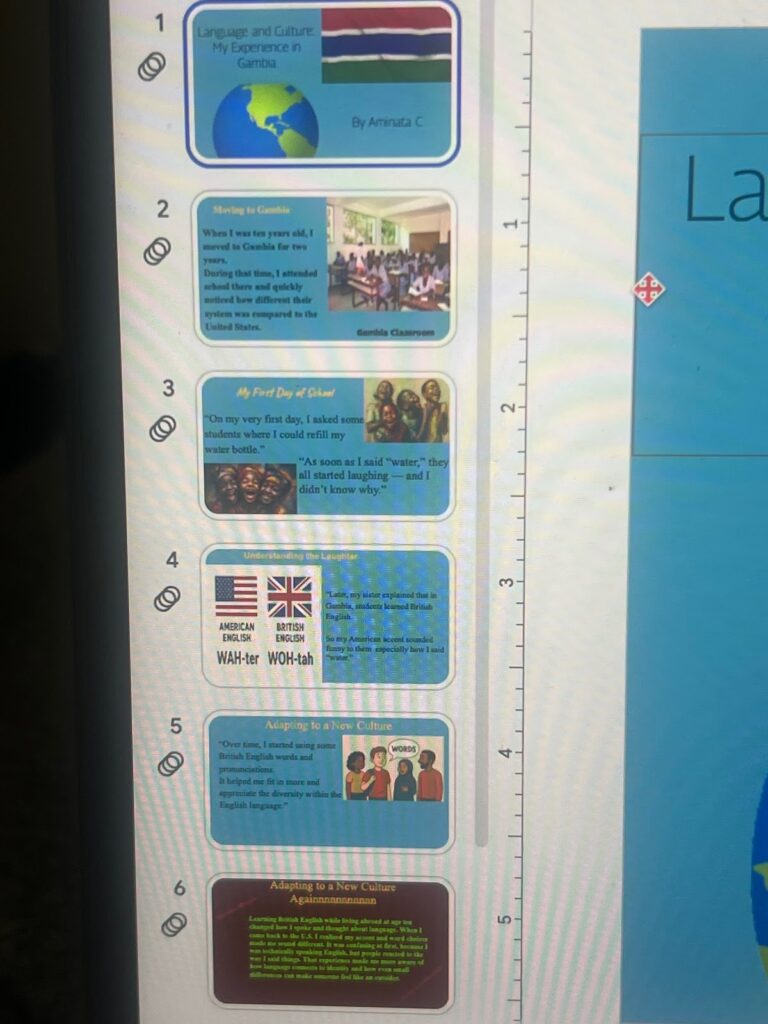
In my LLN, I realized something important about language and learning: instead of just asking what’s “correct,” we can also ask where the idea of “correct” comes from, and when it really matters.
We read and talked about June Jordan’s essay “Nobody Mean More to Me Than You,” which explains some of the rules of Black English. Some of the guidelines she mentions are:
- Say a lot with a little: Use the smallest number of words to get your meaning across. This makes the language punchy and sometimes even poetic.
- Make it understandable: If people can’t understand the sentence, it’s not really Black English.
- Use active verbs: Try not to use forms of “to be.” Using stronger verbs gives your sentences more energy and precision.
My score 0-5: 3
Learning Objective #2: Explore and analyze, in writing and reading, a variety of genres and rhetorical situations.
My paraphrase:
I learned how to read and write different kinds of texts, like essays and stories and think about why the writer wrote them and how they did it. I practiced figuring out what works best for each type of writing.
Evidence of learning:
In my class assignments and essays, I read different kinds of texts and wrote in different ways. I thought about the audience and purpose for each one and tried to use that in my own writing.
My score (0–5):3
Learning Objective #3: Develop strategies for reading, drafting, collaborating, revising, and editing.
My paraphrase:
I learned how to read and write better by trying different strategies, like making drafts, getting feedback, and fixing my work. I also practiced working with others to make my writing stronger.
Evidence of learning:
For my essays and projects, I wrote multiple drafts, shared my work with classmates or teachers for feedback, and then edited it before turning it in. This helped my writing get clearer and better.
My score (0–5): 4
Learning Objective #4: Recognize and practice key rhetorical terms and strategies when engaged in writing situations.
My paraphrase:
I learned how to notice and use important writing strategies, like logos, ethos, and pathos, to make my writing stronger. I practiced using these tricks in my essays to get my ideas across better.
Evidence of learning:
In my essays, I tried using emotions to support my points. I also looked at how other writers used these strategies to help me improve my own writing.
My score (0–5): 3
Learning Objective #5: Understand and use print and digital technologiesto address a range of audiences.
My paraphrase:
I learned how to use different tools, like papers, slides, or online stuff, to get my ideas across to different people. I practiced thinking about what works best depending on who I’m talking to.
Evidence of learning:
In my projects and essays, I used things like slides, Google Docs, and other digital tools to show my ideas. I tried to make my work fit the audience, like using visuals explanations.
My score (0–5):4
Learning Objective #6: Locate research sources (including academic journal articles, magazine and newspaper articles) in the library’s databases or archives and on the Internet and evaluate those sourcesfor credibility, accuracy, timeliness, and bias.
My paraphrase:
I learned how to find research sources, like articles from journals and figure out if they’re reliable. I practiced checking if the info is accurate and fair and if the source might be biased.
Evidence of learning:
For my essays, I used library databases and the Internet to find sources. I made sure the sources were trustworthy and relevant, and I thought about any bias before using them in my writing.
My score (0–5):5
Learning Objective #7: Compose texts that integrate a stance with appropriate sources, using strategies such as summary, analysis, synthesis, and argument.
My paraphrase:
I learned how to show my own opinion in my writing and back it up with sources. I practiced not just summarizing what other people said, but actually explaining it, connecting it to my ideas, and using different sources together to support my point.
Evidence of learning:
In my synthesis essay, I made a clear argument and used quotes and examples from different texts to back it up. I tried to explain how the sources related to each other and to my own point instead of just putting them in randomly.
My score (0–5):5
Learning Objective #8: Practice citing sources accurately and consistently.
My paraphrase:
I learned how to properly cite my sources so that I give credit to the original authors. I practiced using in text citations and a Works Cited page, and I worked on paraphrasing ideas in my own words instead of copying directly from the text.
Evidence of learning:
In my essays I used MLA in text citations and made a Works Cited page. I checked that all of my sources were cited correctly and that my citations were consistent throughout the paper.My score (0–5): 4

